
Miami, FL — Alphabet-owned Waymo has officially launched its autonomous ride-hailing service in Miami, marking a major milestone for self-driving technology in South Florida. The rollout comes as federal regulators investigate safety concerns involving the company’s robotaxis, underscoring the tension between rapid innovation and public safety.
The launch positions Miami as one of the most important testing grounds for autonomous mobility in the United States.
Waymo’s Miami debut marks its sixth U.S. market, expanding its footprint beyond cities like Phoenix, San Francisco, and Los Angeles.
Key details of the rollout:
Over 10,000 people reportedly signed up to access the service during its early rollout phase, highlighting strong interest in autonomous mobility in Miami.
The launch coincides with investigations by U.S. safety agencies into Waymo robotaxis after reports that vehicles failed to stop for school buses in multiple incidents.
Key facts from regulators and media reports:
Although no major injuries have been reported in these reported incidents, the probes raise questions about how autonomous vehicles interpret complex real-world traffic scenarios.
Miami presents one of the most challenging environments for self-driving technology due to:
Waymo has stated that its AI-driven system is designed to operate reliably in these conditions, though vehicles may pause during extreme weather.
| Factor | Human Drivers | Autonomous Vehicles |
|---|---|---|
| Reaction time | Variable | Algorithm-driven |
| Error sources | Fatigue, distraction | Software, sensor limitations |
| Traffic law compliance | Inconsistent | Programmed compliance |
| Adaptability | High intuition | Data-driven decision-making |
This contrast highlights why autonomous vehicles can reduce certain risks while introducing new technical challenges.
Even with autonomous driving systems, vehicle safety still depends heavily on traditional mechanical components.
Autonomous vehicles rely on:
Advanced driverless vehicles still depend on conventional braking systems for:
As autonomous fleets expand in Miami, the importance of reliable tires and brakes becomes even more critical—not just for human drivers, but for AI-controlled vehicles operating in mixed traffic environments.
Waymo is not alone in targeting Miami. Other companies are exploring or planning autonomous services, signaling a growing battle for dominance in the robotaxi market.
Key trends:
Miami’s strategic location, tourism economy, and dense urban layout make it an ideal proving ground for next-generation mobility.
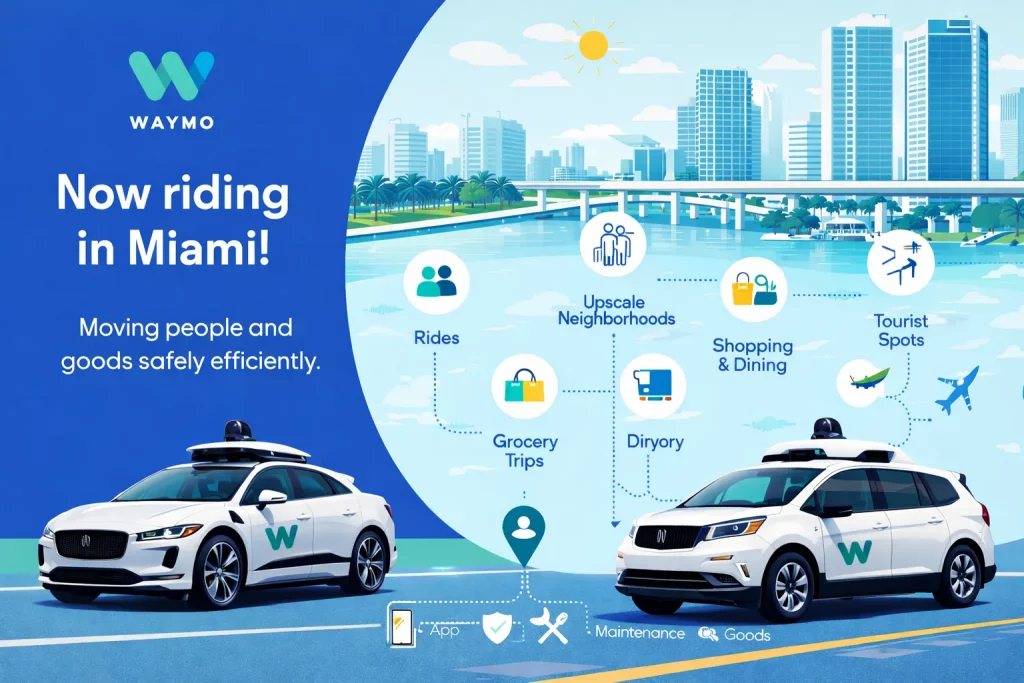
This dynamic illustrates why autonomous technology and traditional vehicle safety systems must evolve together.
For everyday drivers, the rise of autonomous vehicles may change how roads function—but it does not eliminate the need for mechanical reliability and defensive driving.
Waymo’s launch in Miami represents a turning point in urban mobility, placing South Florida at the forefront of autonomous vehicle adoption in the United States.
Yet the simultaneous safety investigations reveal a fundamental truth about self-driving technology:
Innovation is accelerating faster than regulation—and real-world road conditions remain the ultimate test.
As autonomous vehicles integrate into Miami’s streets, the intersection of AI technology and traditional vehicle safety will define the future of transportation.